Which of the Following Is Not Considered a Fine Art

The visual arts are art forms such as painting, drawing, printmaking, sculpture, ceramics, photography, video, filmmaking, design, crafts and architecture. Many creative disciplines such as performing arts, conceptual art, and textile arts besides involve aspects of visual arts likewise as arts of other types. Besides included within the visual arts[1] are the applied arts[2] such as industrial design, graphic design, mode pattern, interior design and decorative art.[3]
Current usage of the term "visual arts" includes fine art as well as the applied or decorative arts and crafts, but this was not ever the example. Before the Craft Movement in Britain and elsewhere at the turn of the 20th century, the term 'artist' had for some centuries oftentimes been restricted to a person working in the fine arts (such as painting, sculpture, or printmaking) and not the decorative arts, craft, or practical Visual arts media. The stardom was emphasized by artists of the Arts and Crafts Move, who valued colloquial art forms as much as high forms.[4] Art schools made a distinction between the fine arts and the crafts, maintaining that a craftsperson could not exist considered a practitioner of the arts.

The increasing tendency to privilege painting, and to a bottom caste sculpture, above other arts has been a feature of Western fine art as well as Due east Asian art. In both regions painting has been seen as relying to the highest degree on the imagination of the creative person, and the furthest removed from transmission labour – in Chinese painting the nearly highly valued styles were those of "scholar-painting", at to the lowest degree in theory practiced by gentleman amateurs. The Western bureaucracy of genres reflected similar attitudes.
Education and training [edit]
Training in the visual arts has by and large been through variations of the apprentice and workshop systems. In Europe the Renaissance movement to increase the prestige of the artist led to the academy organization for training artists, and today most of the people who are pursuing a career in arts train in art schools at tertiary levels. Visual arts have now become an constituent subject in near didactics systems.[5] [6]
Drawing [edit]
Drawing is a means of making an prototype, illustration or graphic using any of a wide variety of tools and techniques available online and offline. It by and large involves making marks on a surface past applying pressure level from a tool, or moving a tool beyond a surface using dry media such every bit graphite pencils, pen and ink, inked brushes, wax colour pencils, crayons, charcoals, pastels, and markers. Digital tools, including pens, stylus, that simulate the effects of these are also used. The chief techniques used in cartoon are: line drawing, hatching, crosshatching, random hatching, shading, scribbling, stippling, and blending. An artist who excels in cartoon is referred to every bit a draftsman or draughtsman.[7]
Cartoon and painting goes back tens of thousands of years. Fine art of the Upper Paleolithic includes figurative art offset betwixt about xl,000 to 35,000 years ago. Not-figurative cave paintings consisting of hand stencils and simple geometric shapes are even older. Paleolithic cave representations of animals are found in areas such as Lascaux, France and Altamira, Spain in Europe, Maros, Sulawesi in Asia, and Gabarnmung, Australia.
In aboriginal Egypt, ink drawings on papyrus, often depicting people, were used as models for painting or sculpture. Drawings on Greek vases, initially geometric, afterwards developed to the human form with black-effigy pottery during the seventh century BC.[viii]
With newspaper becoming common in Europe by the 15th century, drawing was adopted by masters such as Sandro Botticelli, Raphael, Michelangelo, and Leonardo da Vinci who sometimes treated cartoon as an fine art in its own right rather than a preparatory phase for painting or sculpture.[9]
Painting [edit]


Painting taken literally is the practice of applying pigment suspended in a carrier (or medium) and a binding agent (a mucilage) to a surface (support) such as newspaper, canvas or a wall. All the same, when used in an artistic sense it means the employ of this action in combination with drawing, composition, or other aesthetic considerations in order to manifest the expressive and conceptual intention of the practitioner. Painting is also used to express spiritual motifs and ideas; sites of this kind of painting range from artwork depicting mythological figures on pottery to The Sistine Chapel to the human being body itself.[10]
History [edit]
Origins and early history [edit]
Like drawing, painting has its documented origins in caves and on rock faces. The finest examples, believed by some to exist 32,000 years onetime, are in the Chauvet and Lascaux caves in southern France. In shades of red, brown, yellow and blackness, the paintings on the walls and ceilings are of bison, cattle, horses and deer.

Paintings of human figures can be establish in the tombs of aboriginal Arab republic of egypt. In the corking temple of Ramses II, Nefertari, his queen, is depicted being led by Isis.[11] The Greeks contributed to painting merely much of their piece of work has been lost. One of the best remaining representations are the Hellenistic Fayum mummy portraits. Some other case is mosaic of the Boxing of Issus at Pompeii, which was probably based on a Greek painting. Greek and Roman art contributed to Byzantine art in the fourth century BC, which initiated a tradition in icon painting.[12]
The Renaissance [edit]
Autonomously from the illuminated manuscripts produced by monks during the Centre Ages, the next significant contribution to European art was from Italy's renaissance painters. From Giotto in the 13th century to Leonardo da Vinci and Raphael at the commencement of the 16th century, this was the richest menses in Italian fine art as the chiaroscuro techniques were used to create the illusion of 3-D space.[13]

Painters in northern Europe besides were influenced by the Italian school. Jan van Eyck from Kingdom of belgium, Pieter Bruegel the Elder from the Netherlands and Hans Holbein the Younger from Germany are among the virtually successful painters of the times. They used the glazing technique with oils to attain depth and luminosity.

Dutch masters [edit]
The 17th century witnessed the emergence of the great Dutch masters such as the versatile Rembrandt who was especially remembered for his portraits and Bible scenes, and Vermeer who specialized in interior scenes of Dutch life.
Baroque [edit]
The Baroque started after the Renaissance, from the tardily 16th century to the late 17th century. Master artists of the Bizarre included Caravaggio, who made heavy utilise of tenebrism. Peter Paul Rubens, a Flemish painter who studied in Italy, worked for local churches in Antwerp and also painted a series for Marie de' Medici. Annibale Carracci took influences from the Sistine Chapel and created the genre of illusionistic ceiling painting. Much of the evolution that happened in the Baroque was because of the Protestant Reformation and the resulting Counter Reformation. Much of what defines the Bizarre is dramatic lighting and overall visuals.[14]
Impressionism [edit]
Impressionism began in French republic in the 19th century with a loose clan of artists including Claude Monet, Pierre-Auguste Renoir and Paul Cézanne who brought a new freely brushed style to painting, oft choosing to paint realistic scenes of modern life outside rather than in the studio. This was achieved through a new expression of artful features demonstrated by brush strokes and the impression of reality. They achieved intense colour vibration by using pure, unmixed colours and brusque castor strokes. The movement influenced art as a dynamic, moving through time and adjusting to newfound techniques and perception of fine art. Attention to particular became less of a priority in achieving, whilst exploring a biased view of landscapes and nature to the artists eye.[fifteen] [16]


Post-impressionism [edit]
Towards the end of the 19th century, several young painters took impressionism a phase farther, using geometric forms and unnatural colour to depict emotions while striving for deeper symbolism. Of detail annotation are Paul Gauguin, who was strongly influenced by Asian, African and Japanese art, Vincent van Gogh, a Dutchman who moved to France where he drew on the strong sunlight of the south, and Toulouse-Lautrec, remembered for his vivid paintings of nighttime life in the Paris district of Montmartre.[17]
Symbolism, expressionism and cubism [edit]
Edvard Munch, a Norwegian artist, adult his symbolistic approach at the terminate of the 19th century, inspired by the French impressionist Manet. The Scream (1893), his most famous work, is widely interpreted as representing the universal feet of modern man. Partly as a outcome of Munch'south influence, the German expressionist movement originated in Deutschland at the offset of the 20th century every bit artists such as Ernst Kirschner and Erich Heckel began to distort reality for an emotional effect.
In parallel, the style known as cubism developed in France as artists focused on the book and space of sharp structures within a composition. Pablo Picasso and Georges Braque were the leading proponents of the movement. Objects are broken up, analyzed, and re-assembled in an abstracted form. Past the 1920s, the fashion had adult into surrealism with Dali and Magritte.[eighteen]
Printmaking [edit]
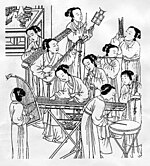
Ancient Chinese engraving of female person instrumentalists
Printmaking is creating, for artistic purposes, an image on a matrix that is and so transferred to a ii-dimensional (flat) surface past means of ink (or another form of pigmentation). Except in the case of a monotype, the same matrix can be used to produce many examples of the print.

Historically, the major techniques (also called media) involved are woodcut, line engraving, carving, lithography, and screen printing (serigraphy, silk screening) simply in that location are many others, including modernistic digital techniques. Normally, the print is printed on newspaper, just other mediums range from cloth and vellum to more modernistic materials.
European history [edit]
Prints in the Western tradition produced earlier about 1830 are known as quondam main prints. In Europe, from around 1400 AD woodcut, was used for primary prints on paper by using printing techniques developed in the Byzantine and Islamic worlds. Michael Wolgemut improved German woodcut from most 1475, and Erhard Reuwich, a Dutchman, was the beginning to use cantankerous-hatching. At the end of the century Albrecht Dürer brought the Western woodcut to a stage that has never been surpassed, increasing the condition of the single-leaf woodcut.[19]
Chinese origin and practice [edit]

In China, the art of printmaking developed some 1,100 years ago as illustrations aslope text cut in woodblocks for printing on newspaper. Initially images were mainly religious merely in the Song Dynasty, artists began to cut landscapes. During the Ming (1368–1644) and Qing (1616–1911) dynasties, the technique was perfected for both religious and creative engravings.[twenty] [21]
Evolution in Japan 1603–1867 [edit]

Woodblock press in Nihon (Japanese: 木版画, moku hanga) is a technique best known for its employ in the ukiyo-eastward artistic genre; withal, it was likewise used very widely for printing illustrated books in the same menses. Woodblock printing had been used in China for centuries to print books, long before the advent of movable type, but was only widely adopted in Nippon during the Edo period (1603–1867). Although similar to woodcut in western printmaking in some regards, moku hanga differs greatly in that water-based inks are used (as opposed to western woodcut, which uses oil-based inks), assuasive for a wide range of vivid color, glazes and color transparency.
Photography [edit]
Photography is the process of making pictures by means of the activity of light. The light patterns reflected or emitted from objects are recorded onto a sensitive medium or storage flake through a timed exposure. The process is washed through mechanical shutters or electronically timed exposure of photons into chemic processing or digitizing devices known equally cameras.
The give-and-take comes from the Greek φως phos ("low-cal"), and γραφις graphis ("stylus", "paintbrush") or γραφη graphê, together meaning "drawing with lite" or "representation past means of lines" or "drawing." Traditionally, the production of photography has been called a photo. The term photograph is an abridgement; many people also phone call them pictures. In digital photography, the term image has begun to replace photo. (The term image is traditional in geometric optics.)
Compages [edit]

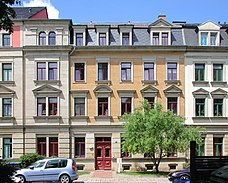
Architecture is the process and the product of planning, designing, and constructing buildings or any other structures. Architectural works, in the textile form of buildings, are often perceived as cultural symbols and as works of fine art. Historical civilizations are ofttimes identified with their surviving architectural achievements.
The earliest surviving written work on the subject of architecture is De architectura, by the Roman architect Vitruvius in the early 1st century Advertizement. According to Vitruvius, a skilful building should satisfy the three principles of firmitas, utilitas, venustas, normally known by the original translation – firmness, article and delight. An equivalent in modern English would be:
- Durability – a building should stand robustly and remain in expert status.
- Utility – it should exist suitable for the purposes for which information technology is used.
- Beauty – it should be aesthetically pleasing.
Building start evolved out of the dynamics between needs (shelter, security, worship, etc.) and means (available building materials and attendant skills). As human cultures adult and knowledge began to be formalized through oral traditions and practices, building became a craft, and "architecture" is the proper noun given to the virtually highly formalized and respected versions of that craft.
Filmmaking [edit]
Filmmaking is the procedure of making a motion-picture, from an initial conception and research, through scriptwriting, shooting and recording, animation or other special effects, editing, audio and music work and finally distribution to an audition; it refers broadly to the cosmos of all types of films, embracing documentary, strains of theatre and literature in film, and poetic or experimental practices, and is oft used to refer to video-based processes likewise.
Figurer art [edit]

Visual artists are no longer express to traditional Visual arts media. Computers have been used equally an e'er more common tool in the visual arts since the 1960s. Uses include the capturing or creating of images and forms, the editing of those images and forms (including exploring multiple compositions) and the final rendering or press (including 3D press). Computer art is any in which computers played a part in production or display. Such fine art can exist an image, sound, animation, video, CD-ROM, DVD, video game, website, algorithm, functioning or gallery installation. Many traditional disciplines are now integrating digital technologies and, as a issue, the lines betwixt traditional works of art and new media works created using computers have been blurred. For instance, an artist may combine traditional painting with algorithmic fine art and other digital techniques. As a outcome, defining estimator art by its end product tin can be difficult. Nevertheless, this type of art is outset to appear in art museum exhibits, though it has yet to bear witness its legitimacy as a form unto itself and this engineering is widely seen in contemporary fine art more as a tool rather than a grade as with painting. On the other paw, there are computer-based artworks which belong to a new conceptual and postdigital strand, assuming the same technologies, and their social impact, as an object of inquiry.
Reckoner usage has blurred the distinctions betwixt illustrators, photographers, photo editors, 3-D modelers, and handicraft artists. Sophisticated rendering and editing software has led to multi-skilled paradigm developers. Photographers may become digital artists. Illustrators may get animators. Handicraft may be computer-aided or employ computer-generated imagery as a template. Reckoner prune art usage has too made the clear stardom between visual arts and page layout less obvious due to the easy admission and editing of prune fine art in the process of paginating a certificate, particularly to the unskilled observer.
Plastic arts [edit]
Plastic arts is a term for art forms that involve physical manipulation of a plastic medium by moulding or modeling such every bit sculpture or ceramics. The term has also been applied to all the visual (non-literary, non-musical) arts.[22] [23]
Materials that can be carved or shaped, such every bit rock or forest, concrete or steel, take besides been included in the narrower definition, since, with appropriate tools, such materials are likewise capable of modulation.[ citation needed ] This use of the term "plastic" in the arts should non exist confused with Piet Mondrian's use, nor with the motion he termed, in French and English, "Neoplasticism."
Sculpture [edit]
Sculpture is three-dimensional artwork created by shaping or combining hard or plastic material, audio, or text and or light, usually stone (either rock or marble), clay, metallic, glass, or wood. Some sculptures are created directly by finding or etching; others are assembled, congenital together and fired, welded, molded, or bandage. Sculptures are oftentimes painted.[24] A person who creates sculptures is chosen a sculptor.
Because sculpture involves the use of materials that can be moulded or modulated, it is considered i of the plastic arts. The bulk of public art is sculpture. Many sculptures together in a garden setting may be referred to every bit a sculpture garden. Sculptors do non always make sculptures by hand. With increasing technology in the 20th century and the popularity of conceptual art over technical mastery, more than sculptors turned to art fabricators to produce their artworks. With fabrication, the artist creates a design and pays a fabricator to produce it. This allows sculptors to create larger and more than circuitous sculptures out of textile like cement, metal and plastic, that they would not be able to create by hand. Sculptures tin too be made with 3-d printing technology.
U.s.a. copyright definition of visual art [edit]
In the The states, the law protecting the copyright over a piece of visual fine art gives a more restrictive definition of "visual art".[25]
A "work of visual fine art" is —
(i) a painting, drawing, impress or sculpture, existing in a single copy, in a limited edition of 200 copies or fewer that are signed and consecutively numbered by the writer, or, in the case of a sculpture, in multiple cast, carved, or made sculptures of 200 or fewer that are consecutively numbered past the author and bear the signature or other identifying marking of the author; or
(ii) a nevertheless photographic image produced for exhibition purposes just, existing in a single copy that is signed by the writer, or in a limited edition of 200 copies or fewer that are signed and consecutively numbered past the writer.A work of visual fine art does not include —
(A)(i) whatever poster, map, earth, nautical chart, technical drawing, diagram, model, applied art, motion picture or other audiovisual work, book, magazine, paper, periodical, information base of operations, electronic information service, electronic publication, or similar publication;
(2) whatever merchandising particular or advertizement, promotional, descriptive, roofing, or packaging material or container;
(three) whatever portion or part of any item described in clause (i) or (2);
(B) whatsoever piece of work made for hire; or
(C) any work not subject to copyright protection under this championship.
See also [edit]
- Art materials
- Asemic writing
- Collage
- Crowdsourcing artistic work
- Décollage
- Environmental fine art
- Found object
- Graffiti
- History of art
- Illustration
- Installation fine art
- Interactive art
- Mural art
- Mathematics and fine art
- Mixed media
- Portraiture
- Process art
- Recording medium
- Sketch (drawing)
- Sound art
- Vexillography
- Video art
- Visual arts and Theosophy
- Visual impairment in art
- Visual verse
References [edit]
- ^ An Nigh.com article by art expert, Shelley Esaak: What Is Visual Fine art?
- ^ Dissimilar Forms of Art – Applied Art. Buzzle.com. Retrieved 11 Dec 2010.
- ^ "Heart for Arts and Blueprint in Toronto, Canada". Georgebrown.ca. fifteen Feb 2011. Archived from the original on 28 October 2011. Retrieved 30 October 2011.
- ^ Art History: Arts and crafts Move: (1861–1900). From World Wide Arts Resources Archived 13 October 2009 at the Portuguese Web Archive. Retrieved 24 October 2009.
- ^ Ulger, Kani (i March 2016). "The creative training in the visual arts instruction". Thinking Skills and Creativity. 19: 73–87. doi:10.1016/j.tsc.2015.10.007. ISSN 1871-1871.
- ^ Adrone, Gumisiriza. "School of industrial art and pattern".
- ^ "cartoon | Principles, Techniques, & History". Encyclopedia Britannica . Retrieved 12 August 2020.
- ^ History of Drawing. From Dibujos para Pintar. Retrieved 23 October 2009.
- ^ "Drawing". History.com. 2006. Archived from the original on fourteen March 2009. Retrieved 23 October 2009.
- ^ "painting | History, Elements, Techniques, Types, & Facts". Encyclopedia Britannica . Retrieved 12 August 2020.
- ^ History of Painting. From History World. Retrieved 23 October 2009.
- ^ "Art history | visual arts". Encyclopedia Britannica . Retrieved 12 August 2020.
- ^ History of Renaissance Painting. From ART 340 Painting. Retrieved 24 October 2009.
- ^ Mutsaers, Inge. "Ashgate Joins Routledge – Routledge" (PDF). Ashgate.com. Retrieved 15 Oct 2018.
- ^ "Impressionist art & paintings, What is Impressionist fine art? Introduction to Impressionism". Retrieved 24 September 2018.
- ^ Impressionism. Webmuseum, Paris. Retrieved 24 October 2009
- ^ Mail service-Impressionism. Metropolitan Museum of Art. Retrieved 25 October 2009.
- ^ Modern Fine art Movements. Irish Art Encyclopedia. Retrieved 25 October 2009.
- ^ The Printed Image in the West: History and Techniques. The Metropolitan Museum of Art. Retrieved 25 October 2009.
- ^ Engraving in Chinese Art. From Engraving Review Archived 29 July 2012 at archive.today. Retrieved 23 October 2009.
- ^ The History of Engraving in Red china. From ChinaVista. Retrieved 25 October 2009.
- ^ Art Terminology at KSU [ dead link ]
- ^ "Merriam-Webster Online (entry for "plastic arts")". Merriam-webster.com. Retrieved 30 October 2011.
- ^ Gods in Color: Painted Sculpture of Classical Antiquity 22 September 2007 Through twenty Jan 2008, The Arthur M. Sackler Museum Archived 4 January 2009 at the Wayback Machine
- ^ "Copyright Law of the Us – Chapter 1 (101. Definitions)". .gov. Retrieved 30 Oct 2011.
Bibliography [edit]
- Barnes, A. C., The Art in Painting, 3rd ed., 1937, Harcourt, Caryatid & World, Inc., NY.
- Bukumirovic, D. (1998). Maga Magazinovic. Biblioteka Fatalne srpkinje knj. br. 4. Beograd: Narodna knj.
- Fazenda, M. J. (1997). Between the pictorial and the expression of ideas: the plastic arts and literature in the trip the light fantastic of Paula Massano. n.p.
- Gerón, C. (2000). Enciclopedia de las artes plásticas dominicanas: 1844–2000. 4th ed. Dominican Republic s.n.
- Oliver Grau (Ed.): MediaArtHistories. MIT-Press, Cambridge 2007. with Rudolf Arnheim, Barbara Stafford, Sean Cubitt, W. J. T. Mitchell, Lev Manovich, Christiane Paul, Peter Weibel a.o. Rezensionen
- Laban, R. 5. (1976). The language of movement: a guidebook to choreutics. Boston: Plays.
- La Farge, O. (1930). Plastic prayers: dances of the Southwestern Indians. n.p.
- Restany, P. (1974). Plastics in arts. Paris, New York: n.p.
- University of Pennsylvania. (1969). Plastics and new art. Philadelphia: The Falcon Pr.
External links [edit]
- ArtLex – online dictionary of visual fine art terms.
- Calendar for Artists – calendar listing of visual fine art festivals.
- Fine art History Timeline by the Metropolitan Museum of Art.
Source: https://en.wikipedia.org/wiki/Visual_arts
Belum ada Komentar untuk "Which of the Following Is Not Considered a Fine Art"
Posting Komentar